Sunday, November 11, 2007

Ireland 2007 Part 12: Dublin and the Grand Canal.


On our last too short day in Dublin, we started early to gain a satisfying stroll before leaving for the airport. Following a hearty breakfast, we made our way again to the River Liffey. We joined the river, as well as the bustling morning commuters, for a walk downstream along the bachelors' quay toward the Grand Canal. Arriving at the Grand Canal, we started at the industrial docks amid heavy construction and headed south on the canal.

Once away from the
frantic congestion we relished the stroll through the quieter neighborhoods along the canals' banks. The canal narrowed as we followed, passing locks and Victorian bridges. As we leisurely walk, we spy a barge anchored in the canal serving as a wine bistro. The morning commute seems almost serene along this portion of the canal and we are sorry to depart the canals' banks as our time grows short.

Soon we are back in the
hectic scurry of the morning, we make our way back through Merrion Square and St.Stephen's Green before arriving at Grafton Street. Traveling back to the Liffey for one last look along it's banks before sadly returning to the hotel to pack. The morning's poignant stroll has not satiated our appetite for this island as we sadly returned to our hotel for the last time. After packing and checking out we grabbed a taxi to take us to Dublin Airport. After our arrival at the airport we watched several showers pass over before uneventfully boarded our flight home.
.
.
.
To see the rest of the pictures go HERE.

Ireland 2007 Part 11: Dublin and Dublin Castle.


We awoke, peeked outside and found the rain was still with us. Slowly we rose, not feeling rushed to start the day. We eventually found our way downstairs to breakfast and discovered the rain slacking as we finished eating. Starting our trek, we found the air cooler but thankfully no rain, we headed toward the Tourist Information office to plan our day. On the way we strolled through the grounds and gift shop of Trinity College, where Kate made several purchases. Arriving at the TI office too early we were met by locked doors and other travelers waiting around the entrance. Once open, Kate looked for more gift and I for plans on our day, we found neither and decided to wing it. We passed the Bank of Ireland, formerly a British Government Building, then worked our way through town. We casually strolled past the Georgian Row Houses, then through the two main parks at city center, Merrion Square and St. Stephen's Green. We found an amateur art exhibit surrounding Merrion Square, as well as crews setting up a stage and tent for an upcoming concert within the park. After departing St. Stephen's, we trekked up Grafton Street before diverting west.

We eventually arrived near the
Dublin Castle and decided to join a tour. The wait wasn't as long as the queue suggested and we were soon roaming the elegant halls and rooms of the Government Complex, formerly the fortified seat of British rule in Ireland until 1922. First founded in by King John in 1204, the building has fulfilled many roles throughout it's history. After touring the building, we soon head to the foundations of the castle to explore recent excavations that hint to the buildings origins. Dublin, in Irish tongue, means "black pool" and we are looking at the original black pool and quay where supplies were loaded and battles fought. After our tour we continued west past Christ Church and St. Audoen's and soon arrived at the Brazen Head, Europe's oldest pub. A pub has occupied this spot continuously since 1198. We find a comfortable table near the fireplace and settle in for a pint before exploring Dublin further.

Back on the street again we follow the
Liffey as it cuts through town, dividing the more affluent south from the working class north, arriving at O'Connell Bridge where we divert our path and follow O'Connell Street north. O'Connell street is one of Europe's widest avenues, often compared to Paris' Champs-Élysées for it's wide and simple but elegant layout. We tracked Connelly street north past the General Post Office, site of the Easter Rising in 1912, and observed the historical statues that dot this wide avenue. Soon we arrived at the Spire, also called "the Stiletto in the Ghetto", rising from the median and grabbed a picture. We continued toward Parnell Square and soon arrived at the Rotunda to make our way west past the Rotunda Hospital, Europe's first maternity facility. We soon found ourselves in an open air street market that had just recently vacated for the evening, leaving empty tables and debris strewn on the pavement. This scruffy working class neighborhood was off the beaten track and a stark contrast to the environment on the other side of the river. We then made our way back to the Liffey.

Soon we were back at the river and followed it's northern quay, past the
Four Courts building, across the Ha'Penny Bridge, before again visiting the Temple Bar District. The sun seemed to stand still on the horizon as the gloaming, or long, muted sunset of the extreme north, had hold of the evening. We paused to watch several street performers, one performer was playing a "violin" he constructed from a paint can and wood carved by his own hand. Not finding any suitable dinner choices in Temple Bar we returned to Foley's, dined on Irish pub grub. We struck up a pleasant conversation with the American travelers seated next to us, who were also spending their last night in Dublin before returning home the following day. Following dinner we returned to O'Donohue's and found it to be only crowded, not to the extreme of the previous night, and were even able to eventually grab a seat. While listening to the traditional music session being performed, we met a pleasantly inebriated local and his Australian fiancee, as well as a gentleman from Howth who claimed to live next to U2 drummer Larry Mullen Jr. After a few pints and the pleasant company, we found ourselves growing tired and made our exit for a nice stroll through the quiet streets back to the hotel in the still present gloaming. Once back at the hotel we spied a rainbow over the Wicklow Mountains before relaxing and eventually turning in after our busy day.


To see the rest of the pictures go
HERE.

Ireland 2007 Part 10: Dublin and Howth.


We rise to find a beautiful day awaits us. Checking the weather report we discover the sunshine will pass to rain this evening and continue through tomorrow. Following breakfast we decide to seize the gorgeous day and make our way to Howth Head. Following the River Liffey downstream, we pass the Customs House as we near Connelly Station. Once at the station we find our platform and board a train north to Howth. Howth Head is a peninsula located a 15 minute train ride northeast of Dublin and contrary to the short distance separating the two, it seems very distant from the bustling Dublin. The rugged mountain comprising Howth Head has several peaks and, with the exception of the town of Howth on the northwest coast, Howth Head is thinly populated. Nearing our destination we caught sight of a group of morning swimmers congregating on the beach and soon were at our station.

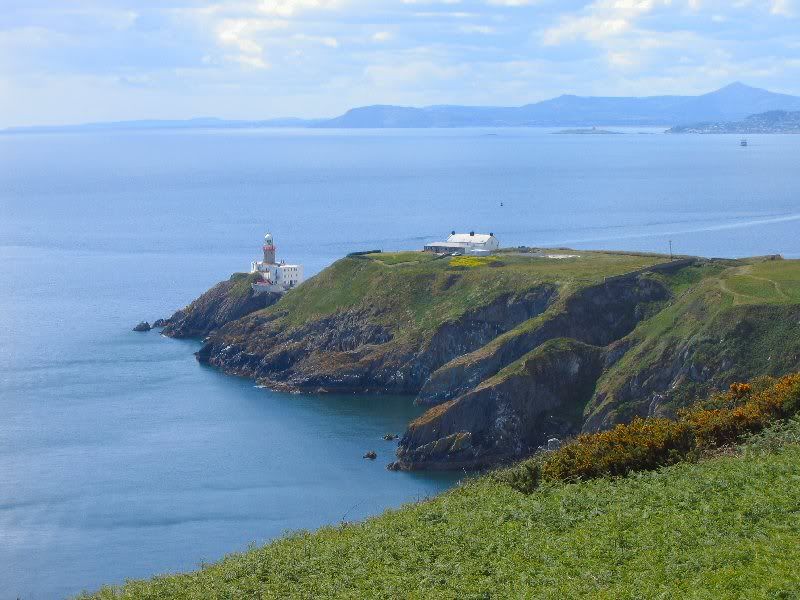
Leaving the train, we strolled toward Howth's harbor. We passed impromptu street performers playing the Godfather Theme as we followed the road out of town, which eventually lead us to the cliff side trail. As we walked we passed the town's Martello Tower and watched the harbor shrink in the distance as the road gained elevation. Looking out over the sea we had a great view of Ireland's Eye, a small island just off the coast. Ireland's Eye used to house a monestary, then a Martello Tower, and now serves as a bird sanctuary. Continuing about a miles' hike brought us to the craggy trail head and soon we were hiking on a narrow path that hugs the coastal cliffs. We continued circumnavigating Howth Head's coast on the high path, looking out over the Irish Sea as boats sailed below on the calm waters. As the trail turned to a westerly direction, Dublin Bay and Howth Head Lighthouse came into view with the Wicklow Mountains as a backdrop. Walking further, we spied a tall ship sailing in the bay. Deciding to explore Howth's heartland, we diverted from the coast and struck out on a trail straight up the the central peak, where we found a parking and observation area. We continued and were soon passing a neighborhood pub as we started our descent from the peak toward Howth. Passing through many opulent neighborhoods, we alternated between following streets and paths until reaching the town of Howth. We found a sandwich shop and purchased a picnic lunch, which we carried to the prominent lookout at the town's Martello Tower. Overlooking the harbor, we ate our lunch as menacing clouds congregated overhead.

Finishing lunch we were soon back at the station boarding a
train to Malahide. After a short train ride we arrive at the bustling town. We briefly explored Malahide before making the wooded stroll to Malahide Castle, located about a half hour's walk from the station. Dark clouds overhead met us as we arrived at the Castle, as well as an overabundance of tourists. We opted to explore the grounds and forego the crowded tour that awaited us inside, then return to the train station. As we arrived at the Malahide station the sky dumped a heavy rain, we counted ourselves lucky as we watched drenched travellers arrive at the station. Soon we were back roaming the Dublin streets, moving our way up the Liffey. Arriving at the Ha'Penney Bridge we dove down an alley into Temple Bar in search of dinner. We found an almost forgettable meal at a local kabob chain and and the rain again found us. After dinner we strolled our way through the soaking shower. Back in Temple Bar we again tried unsuccessfully to find a traditional music session. We settled into a pub, grabbed pints and found a pleasant conversation with the Austrian tourists seated beside us.

Again failing to find the entertainment we sought, we were back to the drenched streets and tried the
Stags Head. Not finding our type of pub we grab a quick conversation with an inebriated rabbit and again braved the elements in search of comfortable surroundings. We decided to set our sights on Foley's Pub, a neighborhood watering hole we found on our first visit to Dublin. Navigating through the constant, drenching rain, we traversed Grafton Street, Merrion Row and finally arrived like drowned ducks at our destination. The heavy rain proved Kate's raincoat had sprung a leak, leaving her cold and soaked. Kate chose a hot tea, I wisely chose a pint and soon we were drying and feeling invigorated. As we sat in the pub's front window watching the street traffic, we noticed O'Donahue's Pub across the street had a very active entry door. With our drinks finished we went to investigate the busy pub across the street. As we opened the door we were greeted by a small pub literally packed wall to wall with a lively crowd. I told Kate there was no room, only to be told by those inside "there's plenty of peck" (room) and the packed sea of humanity parted for us to make our entry. We found not only a bustling pub but a very talented group of musicians conducting a music session. Soon we were consuming rounds and warming in the newly found hospitality we had lucked into. After drying off, warming up and noticing the time getting late, we slid out to the streets to find the rain slacking up to a light drizzle, then set our sights back to our hotel. We soon were settled into bed for a quiet night's slumber.


To see the rest of the pictures go
HERE.

Ireland 2007 Part 9: Belfast to Dublin.


Waking for the last time in Belfast we had to quickly grab breakfast, pack, and get a taxi before racing to the Central Train Terminal to catch a train to Dublin. We arrived at the station with few minutes to spare and after purchasing our tickets, we joined the queue and were soon on the rails. Reflecting on our too brief visit to Northern Ireland, we agreed the scenery was as spectacular as anywhere else in the country we had seen and the people as helpful and friendly as anyone could hope for. We found the dialect in the North was at times as difficult to understand as the dialects in the Scottish Highlands we also found everywhere we went the people were filled with great pride in their country and possessed a boundless optimism for their country's future. After traveling through the rolling countryside in counties Down and Armagh, we were back in the Republic of Ireland. We rejoined the coastline as we made our way to Dublin's Connelly Station. Kate and I have fond memories of traveling to and from this grand old train station and today is no different. We then decided to walk the several blocks to our hotel instead of transferring onto another train and it's next stop. We arrived too early at the hotel to check in so we dropped our bags and immediately were back on the street.

Making our way from the hotel, we stopped next door at the Dublin Fire Brigade's Central Station. One of the firefighters stole a few minutes from his duties to give us a tour of his station, which included a look at their fire pumper, ladder and rescue vehicle. We discussed our two departments and found many more similarities between them than differences. Not wanting to take too much of the firefighters' time, we made our leave and
headed toward Temple Bar. Temple Bar is a located block south of the River Liffey and is the bohemian art/music/tourist district and as such many differing people, from quiet upper and middle class to the more eccentric, congregate there. We strolled past the many restaurants, shops and pubs in and around the district before settling on Bad Ass Cafe for lunch. The Cafe prides itself on being the place a not yet famous Sinead O'Conner waitressed before gaining fame and notoriety. We had a filling lunch before journeying beyond Temple Bar to the city. We made our way toward Dublin Castle, then Grafton Street, before arriving at Dublin's Metropolitan Grand Masonic Lodge. Popping in the door we met a Brother and were soon sitting in the Lodge's library chatting with the Lodge's Chief Officer. We discussed Freemasonry in Ireland and Ireland's history at length. Our new found Brother also offered us his opinion that Ireland would be one country in the near future. After asking about attending a meeting while I was in Dublin, I was sadly informed all the Lodges had gone dark and would not meet again until Fall. We wandered Dublin a short while more before eventually returning to our hotel for a brief afternoon nap.

Feeling refreshed we then returned to
Temple Bar for a delicious dinner at Mexico to Rome, a restaurant oddly enough serving Mexican and Italian cuisine. We decided the menu was based on most groups of people being torn whether to eat Italian or Mexican, they had apparently chosen both to double their customer base. Making our way back to the street we decided against our plans to attend the Musical Pub Crawl after seeing the long line of attendees, instead throwing fate to the wind we searched out our own entertainment. After investigating several venues that were beyond too crowded we settled into the Quay Bar and listened to an Irish balladeer as we relaxed with a few pints. On our last visit to Dublin we found the Guinness Brewery was brewing and releasing limited runs of Arthur Guinness' older stout recipes, touted as the Brewmaster Series. On our previous visit Guinness Brew 39 was the "new" brew available, this trip we found Guinness North Star offered. Both "new" recipes were fine, drinkable brews with subtle differences from the standard Guinness, but any Guinness in Dublin, the source, is as fine as it gets. We then made our way back through Temple Bars' streets, passing revelers as we went, and hopped a few more pubs before finally following the busy streets back to our hotel for a deep sleep.

To see the rest of the pictures go HERE

Friday, November 9, 2007

Ireland 2007 Part 8: Black Cab Tour and Belfast.


Again waking from a restful night's sleep, we soon finished breakfast and began our leisurely walk around Belfast. Starting from our hotel's door we made our way east past the Central Rail Terminal to stroll down the River Lagan. As we followed the river we caught sight of the mighty cranes, Sampson and Goliath, which were used to built the Titanic. We soon passed the Albert Bridge and as we approached the Queen Bridge we found ourselves in Thanksgiving Square under the Ring of Thanksgiving statue, then came upon Belfast's famous The Big Fish statue. We broke from quayside and ventured into the city, passing the Custom House we made our way toward the Albert Memorial Clock Tower. Under the tower we found a large fountain with synchronized water patterns and paused to watch the water's performance.

Making our way deeper into the
city, we spotted a spire pointing to the sky and went to investigate. The spire turned out to be a renovation to the Belfast Cathedral's steeple and was still under construction. As we were about to make our way into the cathedral, we took notice of a group of people milling about the park across the street, each person in the group was conspicuously carrying a white helium balloon. When we appraoched the group and inquired, we were told they were parishioners of the cathedral and were performing an awareness rally for the monstrosities being perpetrated in Darfur, Africa. We sat in the park and watched as they let their balloons free in unison. Carried by the breeze, we watched the balloons as they sailed together over the cathedral. Upon resuming our tour of Belfast Cathedral we were told by our guide that, when finished, the spire would be supported and surrounded by a skylight over the churches' Sanctuary. He also invited us to see the largest cross on a European church, which is located on the north wing of the cathedral. We continued our journey deeper into the city's business district before finding the location of the city's Masonic Lodge, where I was to attend a meeting that evening.

As we made our way into the retail area, we asked a couple of police officers where the Odyssey (and exhibition and retail area) was located. One officer replied, "Hop in and we'll give you a ride there"! Not really all that interested in going but not wanting to turn down what would probably be one of our fondest memories of the trip, we jump in the back seat of the police mini-van. The officers gave us an impromptu tour and told us the history of the city as well as the current redevelopment plans, and indicated a desire for Northern Ireland to unite with the Republic. Once we arrived at the Odyssey we found ourselves on the opposite shore of the
River Lagan from where we had been earlier that morning. After a brief look around, we headed back toward our hotel. Feeling an emptiness in our bellies, we decided on the Crown Saloon for lunch and arrived in time to claim our own vault, or private booth, for our luncheon seating. The vaults are as lavishly decorated as the rest of the pub with meticulous carvings and metalwork throughout and, because isolated by walls and a door, feature bell buttons to summon the waitstaff when needed. We both ordered hearty pub grub and found lunch to be well prepared and satisfying. We returned to our room at the hotel to make arrangements for a guided tour of the Belfast neighborhoods and were told the driver would arrive shortly. We then made our way to the lobby to meet our tour guide.

The Belfast Black Cab arrived and our driver introduced himself as we settled into the back seat. He explained that we would ride, stop and occasionally get out on our tour and he would make it as long as we desired, ask any questions and he would do his best to answer. He further clarified that the city's black cabs fall into two categories, the cabs with yellow plates are not allowed to cross neighborhood lines, only white tags may pass from one side of the Peace Wall to the other. This is because during the Troubles, hit men would hire a cab to carry them to the other neighborhood to carry out their executions before slipping back unnoticed. The white-license plated cabs face higher registration fees and a more rigorous background investigation then their yellow plated counterparts. We began our tour of the politically and religiously differing neighborhoods. First passing the
Divis Tower, site of British espionage, where British Secret Service Agents took over the top two floors to spy on the waring neighborhoods and conduct raids. We soon were in the Republic's (Catholic) Falls Road neighborhood and were shown a long wall of political murals, mostly anti-Bush and other world leaders, as well as raising awareness on topics such as racism, imperialism and of course, the Irish Troubles. Making our way past the Sinn Féin headquarters we soon were in the neighborhood sharing it's back yards with the Peace Wall, the huge concrete and steel barrier separating the Republic's Falls Road (Catholic) area from the Unionist Shankill (Protestant) neighborhood. While in Falls Road we are shown a few of the many memorials to the fallen victims of the troubles. These memorials dot the neighborhoods and we stop to take a solemn stroll. Returning to our cab, we then are driven past several of the old checkpoints, which are now battered, burned and abandoned. We then shown a heavily graffitied wall of more contemporary murals before making our way to the Shankill area. We take notice of the ever present Divis tower looming on the horizon as we ride.

Arriving at the Unionist, Protestant, Shankill neighborhood we were first taken through the more densely populated area and shown the checkpoints, steel bars and spin-gates protecting the pubs and shops. Driving on toward the square, our guide explains the huge piles of
wood and debris that fill the entire square are for the annual bonfire rally scheduled to take place the following week. All around the square are Unionist murals and in the background we again detected the ominous Divas Tower's presence. Our driver explained how the government pays the neighborhood £6000 pounds sterling to re-paint the political murals with more upbeat, non partisan images such as historical figures and events but still find numerous divisive murals that have come to represent this area. Our driver is one of many Northern Irish we met on our trip that shared their desire for Ireland's Uniting under the Republic and belief that it would occur in the not too distant future. We then arrived at another neighborhood square and found numerous murals dotting the perimeter of the mostly empty park. After studying the murals we moved to a desolate and dilapidated neighborhood and were told the Troubles claimed many people here as well as the neighborhood. Our guide then showed us a house that was ravaged during the Christmas season, the empty tenement was still decorated for the holidays and lit up in full Christmas splendor each night as a sign of defiance.

Returning to our hotel, our guide pointed out a nearby chippy and recommended them as having the best in the city. We then toured
City Hall and were impressed by the building's lavish decor and furnishings. Once finished with our tour, a light shower fell on us as we dashed to the chippy. Settling in we had a cholesterol laden fish and chip dinner in the small, local diner. On our return I called the Lodge to confirm the Masonic meeting I was to attend that evening and was told a driver would soon pick me up. Quickly I readied and was met by two Brothers who chauffeured me to the Lodge to attended a most spirited Meeting. A hearty meal, washed down with pints, followed the meeting as a band, accompamied by the occasional Lodge Brother, entertained those in attendance. After too many Guinnesses, I thanked my hosts for their gracious hospitality and made my way back to the hotel to rejoin Kate for a much needed rest.


To see the rest of the pictures go
HERE.

Ireland 2007 Part 7: Derry to Belfast.


Waking from restful sleep we showered and made our way to breakfast, afterward we checked out of the hotel and departed Derry under a cover of clouds. We soon found ourselves trapped in the rush of cars and buses delivering children to school coupled with the mad dash of businessman's commute. Eventually breaking free from the tangle of cars we arrived at the seaside town of Portrush, perched on the Antrim Coast. We then join the Antrim Coastal Highway to follow the Causeway Coast. As we pass the Portrush Golf Course the limestone and basalt cliffs push the highway up to offer stunning views of the Antrim Coast.

We soon arrived at Dunluce Castle and since the castle wouldn't open for another half hour, we seized the opportunity to explore the surrounding grounds. The Castle, situated on a precipice, is protected on all sides by a steep cliff, access is from a solitary bridge connected to the mainland. Working our way down to the castle's foundation we discover a tunnel cut through the crag to offer a supply conduit to the beach below. Joining the tour we learn some of the history of this strategic location, which included early settlement of the site by Christians and Vikings, then an Irish fort occupying the stronghold. The castle, first built by the Earl of Ulster Richard De Burgh, dates to the year 1200 and was occupied continuously through differing states of repair. In 1588 the Girona, a galleon of the Spanish Armada was wrecked in a storm on the rocks nearby. The cannons from the ship were installed in the gatehouses and the rest of the cargo sold, the funds used to restore the castle. Deterioration of the seaside cliff lead to a rock slide in 1639 which caused the kitchen to collapse into the sea, taking the kitchen staff with it as well. The castle then served as the Ulster seat of power until 1690 when the Battle of the Boyne led to the impoverishment of MacDonnells and the eventual abandonment of the castle. After falling into ruin and being scavenged to serve as materials for nearby construction, the castle is now reclaimed by the Environmental and Heritage Service. After touring the castle we again join the coastal highway and discover a separate castle almost completely in ruin before our arrival at the Giant's Causeway.

Arriving at the
Giant's Causeway visitor's center we parked the car, then hiked along the coast. The easily recognised Giant's Causeway is comprised of an estimated 40,000 vertical basalt columns. Legend has it that the Irish giant Fionn mac Cumhaill (Finn McCool) built the causeway to walk to Scotland to fight his Scottish counterpart Benandonner. Fionn fled after seeing Benandonner's great bulk, and asked his wife to disguise him as a baby. When Benandonner saw the size of the 'infant', he assumed the alleged father, Fionn, must be gigantic indeed. Therefore, Benandonner fled home in terror, ripping up the Causeway in case he was followed by Fionn. The Causeway is famous for being the location shot for the cover of Led Zeppelin's Houses of the Holy album. We joined other visitors exploring the rocky coast and many sided stone columns. We saved some time by choosing to return to the parking lot by bus, and soon are back on the highway.

After a short drive we park and under a welcoming sky as we begin the long
hike to the Carrick-a-Rede bridge. The original rope bridge was re-built each year by the local salmon fisherman to gain access to the tiny island of Carrick for the annual salmon run, now the bridge is made of cable and rope and maintained by the National Trust. The bridge tender takes wind readings to make sure it is safe for us to cross, we then make the windy chasm crossing on the swinging bridge and take in the picturesque scenery on the island. Scotland is in view as we gaze out over the sea before we trek back to our awaiting car. We then made our way down through County Antrim toward Belfast.

As we neared Belfast, the motorway snaked as it descended from the mountains overlooking our destination. Arriving in Belfast with time to spare before our rental car allotment expired, we checked into the hotel and dropped our luggage before dropping the car at the airport. We then hopped a bus to return to Belfast and start a new exploration. We made our way to the
City Hall and plaza to watch as people lazily soaked in the warm sunshine. Crews were setting tents and kiosks for an upcoming festival as we strolled around the massive building. After a leisurely walk around the city to get our bearings we soon were looking for dinner and found the Bourbon Grill the top contender. Kate was impressed by the old Victorian building and decor, I by the well prepared meals. After dining we moved on the the Crown Liquor Saloon and more lavish Victorian decor, as well as bustling atmosphere and a couple of proper pints. Following drinks we further explored the city before settling back to our room for a well deserved slumber.


To see the rest of the pictures go
HERE.

Ireland 2007 Part 6: Donegal to Derry.


Greeted by the ample sunshine of an eastern facing bay window and clear skies, we started our day with a full Irish breakfast then packed up and moved on to the Glenveagh National Park. Before reaching the remote wilderness we first had to inch our way through miles of road construction and commuter traffic. Breaking free from the congestion, we diverted from the main road and found a quiet rolling road through the rugged Glenveagh Park. Finding the scenery similar to the Connemara but less craggy we made our approach to the Glenveagh Castle. The visitor center grounds were well maintained but not extensively manicured, preserving the natural mood of the surrounding wilderness. Soon we boarded a bus for the three mile drive through the grounds to the castle and botanical gardens.

Arriving at the
castle, which is located at the bottom of a wooded mountain on the shore of Lough Veagh, we make our way to the entrance. We were informed the next tour would start in 45 minutes, affording us plenty of time to tour the grounds. The extensive castle gardens are situated adjacent to the castle and offered beautifully manicured and varied botanical displays, surrounded by the craggy wilderness beyond. Finishing our tour of the gardens we made our way back to the castle and were disappointed to learn photography was not allowed in the castle. The tour was extensive and our guide well informed and upon completion of the tour we made our way back to the awating bus.

Once on the
bus Kate initiated a conversation with our driver, which soon turned to talk of ancestry. Upon telling the driver of her Malseed blood, the driver then confessed he knew a Sammy Malseed in Letterkenny and informed Kate that Sammy was a fine, tall strapping man who knew and was liked by everyone, but the driver was unable to recall an address or phone number. Returning to our car we drove east to Northern Ireland. Under a cloudy canopy we stopped on the Republic of Ireland/Northern Ireland line and were pleased to discover no checkpoint. While there we stopped at a diner/supermarket/petrol station for what turned out to be our most disappointing meal of the trip, and the $2.00 US dollar to £1 pound sterling exchange rate made the lunch even less enjoyable.Once back on the road we realized it was still early and we would arrive in Derry with plenty of daylight to explore the walled city.

Arriving in
Derry we found it to be a large, bustling city but easily navigated. We arrived at the City Hotel in no time and checked into our room, then hit the street. First making our way to the river, then following the water's edge to the Guild Hall and Guild Square just outside the city walls. We briefly summited the wall to gain a better vantage of the square and surrounding buildings, as well as the garrison of cannons lining the wall's battlements. Upon our return to the square, our touristy mumblings captured the attention of a gentleman who introduced himself as an off duty tour guide and inquired if we had any questions. Upon our affirmative reply he proceeded to proudly tell us the story of his city, including the history of the city's former populace, seiged but unbreached wall, the Bloody Sunday Massacre, and Derry's proud Irish heritage, as well as hopes for a united Ireland. After exploiting too much of his time, we thanked him and bid farewell.

Navigating the
wall as it snaked up around the old city, we happened upon the craft village filled with shops on the street level and elevated walkways providing access to residences above. After browsing the shops we returned to the wall to continue our exploration. Soon we were overlooking the densely populated and intensely polarized Bogside neighborhood, site of the infamous Bloody Sunday Massacre. From our high vantage point, we could see many of the Bogside buildings' blank sides which have been transformed into large murals, representing the troubles of the city's polarized, bloody past. Some murals depict the bloodshed and loss, while others show a hope for peace and unity. After our tour of the wall we make our way down into Bogside and pay a visit to the Bogside Inn to relax and have a pint in the history filled pub. Inside we found pictures adorned the walls depicting Bloody Sunday and the Troubles. As we moved into the neighborhood we found a cheerful, bustling town full of Irish flags flying at half-staff, the flagpoles themselves, as well as the street's curbs, painted the Republic Flag's orange, white and green. The colors representing; orange for Northern Ireland, green the South's Republic and white in the middle for the hope they will one day come together. Continuing through Bogside, we made our way to the Free Derry wall, "H" block memorial, as well as the Bloody Sunday Memorial, all amid the many murals.

We returned to the
walled city, then headed to the business district in search of dinner. Dinning on comfort food at the bustling American Cafe, we found an an adequate meal that bested our earlier lunch, if just by a little. Feeling rejuvenated and finding the sun revisiting, we journeyed through the residential neighborhoods along the river and found a very quiet and serene stroll, as well as the city's "Reconciliation- Hands Across the Divide" statue. As our shadows grew longer we made our way back through the walled city and ducked into a pub for one last pint before returning to our hotel for a quiet slumber.


To see the rest of the pictures go
HERE.

Ireland 2007 Part 5: Sligo to Donegal.


After waking in Sligo we hit the breakfast buffet and quickly fueled ourselves for a new day. Arriving at the car we discovered I had inadvertently parked under the local flock of birds' favorite tree and found the car dotted with their calling cards. Following a good windshield cleaning and refueling on the car we drove to Lough Gill. Arriving at the lough we found dense woods, along with a large rock formation named Dooney Rock to explore. After our short hike we were back in the car again and made our way up Donegal Bay through Yeats country, passing the ever present and uniquely recognizable Ben Bulben mountain. First noticing Ben Bulben in the distance as we arrived in County Sligo the previous day, we found the grand mountain would be a companion for much of our visit to the Irish northwestern coast. As we arrived at Boa Island we saw a sign for Caldwell Castle and decided to investigate. Parking in a lot surrounded by lush forest, we followed the footpath through the dense growth. After a several minutes of hiking we arrived at the castle and were surprised to find it almost completely concealed beneath a thick carpet of foliage. Signs surrounding the castle indicated the ruins were on the verge of collapse save the dense growth holding the castle together. Soon we arrived on Boa Island and although the sky was blue and the landscape lush, we were disappointed to be unable to locate the ancient Janus stones that dot an old cemetery, so we continued our journey north into County Donegal.

Donegal is a short trip from Boa Island but our next destination lay far beyond the city. After passing by Donegal Town we navigated west along
Donegal Bay's northern coast, passing alternating views of coastline and the large fingers of land that point into the bay at regular intervals. Beyond the town of Killibegs the landscape became more rugged as we neared our goal, the Slieve League. Passing through Teelin, we soon arrived at the lower parking lot and decided to stop there and make the mile hike up the craggy coast on foot to Europe's tallest seaside cliff. Along the way we found ponds, bogs and lakes dotting the rugged landscape and many herds of sheep grazing along the way. As we neared the top of the road we found an old military watchtower, now abandoned, on a lower seemingly isolated level of the cliff. We then arrived at the Slieve League, whose cliffs rise 2000' from sea to the top and follows the coast for several hours' hike. We met some fellow visitors who described the ridge's trail as taking six to eight hours to complete. They informed us that at one point the trail on the high, rocky ridge, named "One Man Pass", is too narrow for two hikers to pass each other. Kate and I chose the short, wide trail up the the ridge's beginning and stopped on the way up for our picnic lunch. Following lunch we continued our upward hike and were amazed as the blue water and sky seem to mix into one as we gazed down on Donegal Bay, with County Mayo and the Atlantic Ocean in the distance. This was literally one of the high points of our trip. We then made our way back down to the road, which we followed back to the car, then drove back to Donegal Town.

Arriving in
Donegal we were lucky to quickly find an afternoon parking spot in this bustling town. We parked and headed into the city, arriving at town center first, we then browsed through some shops and eventually found a cafe for afternoon tea. Once refreshed, we moved to Donegal Castle and explored the castle ruins and grounds first before moving into the renovated main structure. Kate decided the furnished castle would easily accomodate her, and was pleased with the location as well. Leaving no stone unturned during our tour of the castle, we made our way back to the car to locate our night's lodging. We quickly found our B&B on the outskirts of town and took a brief respit before returning to town for dinner and further exploration. Our hostess explained how her B&B occupies their family farm, although still a working farm, is not as active as it had been. The farm still had livestock and limited planting, was only a fraction of what it had been.

Returning to town we conducted short search for dinner. Forgoing the aptly named
Shamrock Chinese, we instead settled on a pleasant bistro and soon we were enjoying a satisfying meal. With dinner and desert finished we hit the streets and strolled past churches, clubs and boutiques in the neighborhoods before arriving at town center once more. We then found a quiet pub to enjoy a pint before returning to our room. On our drive back we spied a unique neighborhood and decided to investigate before returning to our nights' accomodations. This particular neighborhood was surrounded by a large lough and had many large, stately homes and an old stone ruin of what seemed an ancient plantation. With our curiosity satiated we returned to our room where a good night's sleep awaited us.


To see the rest of the pictures go
HERE.

Wednesday, November 7, 2007

Ireland 2007 Part 4: Clifden to Sligo.


After a brisk, invigorating early morning shower at our B&B in Clifden our hostess informed me too late that there'd be no hot water until the afternoon. After the car was loaded we drove into the northern Connemara, again finding the Twelve Bens and beautiful weather accompanying us. Snaking our way further north through the rugged terrain toward Sligo, our path soon took us past Kylemore Abbey. The Abbey once again proved to be a worthy photo stop as well as an opportunity to stretch our legs before heading toward the far end of County Galway. Breaking from the main road after we passed Leanaun, we briefly stopped to see Ashleagh Falls before continuing to County Mayo. Following the scenic trek through the rugged Sheeffery Hills, we admired the many serene loughs that dotted the road toward Louisburgh.

After driving through Louisburgh, we are amazed by the beauty of
Clew Bay as we follow County Mayo's coast. Arriving at Croagh Patrick in late morning we forego the opportunity to climb the mountain where Saint Patrick fasted for 40 days and drove the snakes out of Ireland, and chose instead to watch pilgrims start their ascent as we admired the idyllic scenery. Loading ourselves back into the car we continued our journey along Clew Bay to the quaint town of Westport. Westport, being one of the few planned towns in Ireland, was commissioned by Lord Sligo and designed by John Wyatt in 1780 and proved a charming stop. Among the picturesque features of the town are it's tree lined, flower decorated, promenade and several stone bridges over the River Carrow. We found a quiet bistro and ate lunch before exploring the town further and returning to the car.

Back on the road we then made a brief stop in
Newport before continuing our circumnavigation of Clew Bay. Eventually arriving at the Achill Islands were we discovered a plume of smoke, possibly peat, originating in the town of Sraheens. After a failed attempt to locate the smoke's source we continued our tour of the Achill Islands. Spying across the bay toward our earlier path on the opposite shore, we observed Croagh Patrick and commented on how well the weather was treating us. The local sheep seemed to barely mind us as we watched them go about their business of the day, which I suppose consisted mainly of eating, growing wool and procreating along this picturesque shore.

As the afternoon was turning late we made a dash across County Mayo's heartland into County Sligo as the weather took a turn for the worse. We were pelted by rain as we made our way toward Sligo Town but the sun made a surprise appearance as we neared our hotel. Once settled at our room we made our way to the city streets in search of dinner. Sunday evening in
Sligo found the town subdued and disappointingly empty. Tracing the river's path, we found one of the few restaurants still accepting customers, which offered Italian cuisine and we settled in for a hearty meal. After dinner we explored the town, first following the river then making our way into the more densely developed part of Sligo, eventually finding the ruins of Sligo Abbey. Although closed, our views of the Abbey were remarkable and we were able to see most of the ruins unobstructed. We then made our way back to our room to rest for the upcoming trip to County Donegal and soon found fitful sleep.


To see the rest of the pictures go
HERE.